Steam Frame arrives in Canada with a $1,529 starting price
Valve’s wireless Steam Frame headset will cost from $1,529 CAD, with reservations closing September 17 and purchase invitations expected the following day.
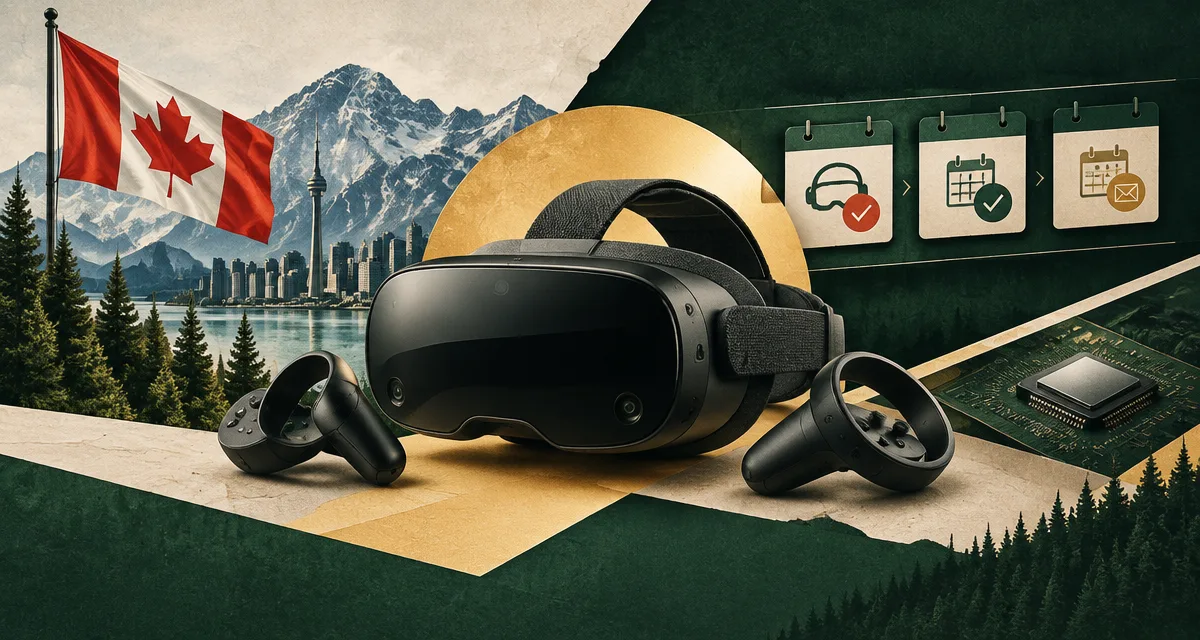
Valve has put a price and reservation system behind the Steam Frame, turning its long-teased virtual-reality headset into a real — if expensive — purchase decision for Canadian PC gamers. The company is accepting registrations through September 17, 2026, at 10 a.m. Pacific Time, with the first purchase invitations expected to go out on September 18. [1]
Canadian pricing starts at $1,529
The Steam Frame will be sold in two configurations. The 256GB model, including two VR controllers, is listed at $1,529 CAD. The 1TB version costs $1,859 CAD. Valve is also offering an ergonomic accessories kit for $69 CAD, while a power adapter and cable are sold separately for $69 CAD, according to published launch pricing. [1]
Those prices place the Frame well above mainstream standalone headsets such as Meta’s Quest line. Valve is positioning the product less as a low-cost VR console and more as a premium Steam device: a wireless headset that can run some games locally while also streaming demanding PC VR titles. The pricing may therefore appeal most to existing Steam users who value the company’s software ecosystem and PC compatibility over the lowest entry cost.
Valve has not described the registration process as a normal open sale. Instead, customers register interest in a specific configuration, and invitations are expected to be issued through a reservation queue. That approach suggests initial supply may be limited, although Valve has not publicly stated how many units will be available. [1]
A standalone SteamOS headset with a streaming-first design
Valve first announced the Steam Frame in November 2025 alongside a new Steam Controller and Steam Machine, promising that all three devices would arrive in 2026. [2] The company describes the Frame as a new way to access a Steam library, rather than a successor designed only for traditional PC-tethered VR.
The headset uses a Qualcomm Snapdragon 8 Gen 3 processor and runs SteamOS on Arm hardware. Steamworks documentation says the device supports native software through compatibility layers for different operating systems and processor architectures, including Proton for Windows games. [3]
The key distinction is the relationship between local and streamed games. Less demanding titles can run directly on the headset, while PC VR games can be transmitted wirelessly from a computer. Valve’s eye-tracking system is intended to support “foveated streaming”: allocating more streaming quality to the part of the image where the player is looking. That could reduce bandwidth demands, but the experience will still depend on the user’s PC, home network and wireless conditions. [4]
The Frame’s hardware includes two 2160-by-2160 LCD displays, pancake lenses, refresh rates of up to 120Hz, Wi-Fi 7 connectivity and 16GB of memory. It also includes internal cameras for eye tracking and external cameras for headset and controller tracking. [4]
The headset’s battery is mounted toward the rear of the strap rather than concentrated entirely at the front. Valve has emphasized the Frame’s relatively low visor weight, though the complete device is heavier once the strap, facial interface and battery are included. [4]
What Canadians should watch before reserving
The Canadian price is the clearest new information, but several practical questions remain. Valve has announced the reservation window and invitation schedule, yet the company has not provided a universal delivery date in the material cited here. Buyers should therefore distinguish between registering for a chance to purchase and receiving a confirmed shipping date. [1]
The separate power-adapter cost is another consideration. The Frame’s headline price does not represent the complete out-of-box purchase if the buyer needs Valve’s listed charger and cable. The accessories kit is optional, but it adds further cost for users who want additional straps, a larger light blocker or other comfort-oriented components. [1]
The Frame’s appeal also depends heavily on the kind of VR a customer wants. For standalone use, its Snapdragon processor and SteamOS support could make it more flexible than a streaming-only headset. For high-end PC VR, however, it is primarily a wireless access point to a more powerful computer. Buyers should not interpret “standalone” as meaning that every demanding PC game will run locally at the same quality.
Compatibility will likewise vary by title. Valve’s Steamworks documentation describes the technology and verification process, but a game’s individual performance can depend on whether it has native support, runs through a compatibility layer or is streamed from a PC. [3]
A premium bet on Steam beyond the PC
The Steam Frame is arriving as part of Valve’s broader 2026 hardware push, which also includes the Steam Machine and redesigned Steam Controller. [2] That makes the headset more significant than a one-off VR refresh: it is another attempt to extend SteamOS and Steam’s library beyond conventional Windows gaming PCs.
For Canada, the central question is value. At $1,529 CAD before optional accessories, the entry model is not positioned as an impulse purchase or a mass-market replacement for inexpensive VR headsets. Its case rests on the combination of Steam integration, wireless PC streaming, eye tracking and the ability to run selected games without a computer.
The reservation deadline arrives before Canadians can assess long-term availability, independent battery testing or the breadth of native software support. Until those questions are answered, the Steam Frame looks less like a Quest competitor aimed at everyone and more like a premium hardware platform for committed Steam and PC VR users.

YFG Fatso’s “Am I Wrong” Gains Early International YouTube Attention
YFG Fatso’s new official video reaches international YouTube trend lists as the rapper continues an active 2026 release cycle.

Cristy Nodal’s “Regalo de Luna” Release Remains Unverified
Publicly available sources do not yet verify a Cristy Nodal release titled “Regalo de Luna,” although the claim is circulating through a supplied YouTube video.

Bengals Turn Four Takeaways Into 33-27 Win Over Buccaneers
Cincinnati’s defense forced four turnovers, including a fumble-return touchdown, as the Bengals held off Tampa Bay 33-27 in the 2026 season opener.